|

A philosophy shared in
four parts.
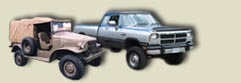
 A Dodge all-wheel-drive
truck is a tool. Time-honored tools are
simple, elegant in their simplicity, and
durable. Fundamental, effective tools will
be kept and used as long as we live. A Dodge all-wheel-drive
truck is a tool. Time-honored tools are
simple, elegant in their simplicity, and
durable. Fundamental, effective tools will
be kept and used as long as we live.
I can learn
something about a man when I enter his shop,
when I look in his toolbox. I can see what he
keeps, what he cares for, and I can learn
something of his style.
In spending time
together, we come to better understand and
honor our common bonds.
Part One
I sit examining an
inspiring publication filled with pieces of
furniture wandering along the gauzy boundary
between exotic furniture and sculpture that
happens to be made of wood. A good share of it
I wouldn't care to own.
I do earnestly
admire the craftsmanship, the patience, the
attention to detail, and the display of skills
I hold in the highest esteem.
Having spent a good
bit of time working with wood, I read the
magazine and imagine me studiously attending
to the birth of a crafted thing, laboring over
the finest details and construction
techniques; honoring the product as a measure
of me, my skill, and my reverence for accuracy
and form.
Do I start? Do I
grasp the first rough board and lay it to
measure with tape and rule? Do I sit bent at
the drawing table to plan the pilgrimage?
No.
Why, then?
It is because I am
daunted by the herculean task.
I think it noble in
the fullest to spend huge lots of time from
one's finite life in the pursuit of any such
honest goal as the production of a solid
table.
Even the word
table has a good sound to it. I savor
it, I want to say it more than once. Twice, or
even three times.
I think I shall
make a table, and it will be good.
Do I mean the table
or the making of it? It will be solid. It will
be home, it will be a foundation.
A foundation for
life... yours and mine. Will this foundation
be the table, or will it be what I learn
during the making of it?
We can gather
around it, you and I, and we can share time
and space. We can think together for a bit. We
will then go on, better for it, and look back
upon the experience fondly.
We sit at a good
table.
That table shall be
at the center of it all, doing what it does
best – being unobtrusive, yet serving us as
required, along with our accessories. Our
drink, our papers and books, our guns and
knives... or whatever we choose to examine.
Together.
Better yet if the
table is something I have personally and
privately labored over. If it is made from
great slabs of wood rescued from the fallen
barn on the old place.
History. Who
lived there before?
Native timbers,
rough hewn from the hearts of trees grown long
ago in these parts and experienced in the
passage of time; both easy and hard. Trees
that knew the sunny days and the violent
storms. Living valiantly through it all.
Being in the
presence of such veteran stuff yields its own
confidence in the possibility of making it to
the morrow unscathed. We have a friend in this
table; the great and strong tree it used to
be. It knows no matter what happens, we will
all be here tomorrow when the sun breaks the
rim of the world.
My soul could
better be in it if I had sawed the wood with
brutish, human labor; if I, with my hands,
planed it. Especially after honing the steel
blade on a bench stone, then testing the edge
on my living skin.
The curled shavings
would fall to the shop's floor and land about
my worn leather boots. All these things good
and natural in color. Smelling, too.
Better if the plane
was very old and very used. My grandfather's
plane, a tool he used to make good things. The
plane even a bit of someone else, made in a
place shaded by steel and smoke, inhabited by
men with coarse cloth shirts, snap-brimmed
caps and rough hands; wooden benches and steel
tools bearing the sheen of use and time. Men
who fished from row boats and ate picnic
lunches from covered baskets wove of peeled
wooden strips.
All of this loops
back on itself and intricately illustrates a
continuity and connectedness between me and
the tree and the earth it came from... and
you, if you sit with me at the table, petting
the dog who patiently stands at your knee.
The dog may have
done his own thing on a tree, a descendant of
the old timer used to build the table. We all
loop together, forming whorls in the grain of
our cosmic forest's wood.
I do not start
because I get lost in the motion and pattern
of all this. I back away in silence and wonder
if I am equal to it.
If my dovetails are
not perfect, have I blasphemed? If the joints
are not tight, is it disrespect for the life
of the tree? Have I squandered the resources
used to grow the oak or pine before me?
Material that lies flat, naked, even
vulnerable before me on the bench. I tremble
in the thinking of it, therefore cannot reach
to touch it.
And so I bring
myself to a place where there is a casting
retaining a precision Timken set guiding an
alloy shaft, itself bearing splines and
various diameters turned; through a cavernous
case filled with refined petroleum, all held
together with graded, threaded fasteners and
the labor of someone manipulating a fine
forged wrench. It is daunting, it is
illuminating, it is humbling, it pierces.
It stills me in
mind and in body.
Consider the
resources mustered in the foundry and in the
forge. The history and experience lost
somewhere in the heart of the assembly now
silent. Waiting passively for touch and the
resultant, exultant motion.
It is all a pattern
in the vaulted ceiling of a cathedral we build
for our deepest fascinations.
It is our
responsibility to care for the parts, know
them well, value their every virtue. Even the
ones not immediate and recognizable. They come
to us in oblique moments, later and farther
away, and perhaps in the middle of something
else.
The truck, it is
solid, too. We can gather with it and talk and
share and know one another. We can travel
forward in space and backward in time. All at
once.
It is good.
This is how I can
spend an hour looking at a part, feeling the
weight, the sharp edges, the drilled holes and
the machined surfaces. Love the texture of the
casting left on much of it. Believing the dirt
upon it is honest and right.
Not a thing to mind
in the dark of a night, alone. The ceiling a
black sky with a single, brilliant moon.
Part Two
A woman and a
teenage boy examine a CD player in a stereo
shop. The boy holds a remote control unit in
his hand, entranced. He pushes buttons and
marvels. She observes.
"How is this
different from the one you have now?" she
asks.
He waves the remote
at her, "With this, I don't have to get out of
bed."
This is not
advanced technology. It is retarding
technology. It needs to be stopped before we
choke on it.
I consider these
things as I load pieces of rough sawn oak in
the back of my truck. They are halves of
railroad ties not ever treated with creosote,
used one time – fresh from the sawmill – as
cribbing for the raising of a house. I am
happy to have them, as I intend to raise my
house. I will need many such blocks, and I
gather them when I can.
I intend to do this
work without a fiber-optic network, without a
laser beam, without a computer. I will do it
with jacks and wood blocks. I will do it by
hand.
I will have to get
out of bed to do it.
Manufacture
once meant to make by hand. That was long ago,
but it certainly communicates the notion that
humans can touch, create and shape. A
connection between people and things. A
healthy and necessary connection.
I once worked with
a machinist who said we should raise our own
green beans, not buy them in metal cans. We
should dig in the soil, plant the seeds. Weed,
water, and pick them. It might seem less
economical than buying beans at the store, but
it would feed us in a number of ways.
We wouldn't need
countless metal cans with printed paper
labels, all ending up at a landfill. Instead,
a glass jar could be used over and over. All
the activities associated with the bean
production would be beneficial to the
participants.
As the process
became less labor-efficient, more people could
be involved. Productively. The work would be
good exercise, providing meaningful activity
for many.
It would be better
than having some people sitting, simply
waiting for that which they have come to feel
entitled. Today we have enormous numbers of
people who are idle, yet they manage to
overconsume. In fact, they feel entitled to
overconsume, at the same time they do not wish
to take work they suggest is beneath them.
I recently walked
through an event called a thieves market. It
was a place where the products of artists were
displayed and sold. Pottery, wood products,
framed and unframed art in a variety of media,
jewelry, textiles, and leather.
None of these
things were made using modern or exotic
technology. None of these things were made at
high speed; neat clones of hundreds before and
hundreds after, produced on computer
controlled mass production equipment.
They represent
craft. They represent human involvement, pride
in the skills and processes, and in the
objects. Things produced in such a manner
allow humans to connect with them. A polar
opposite to the images and sounds emanating
from an electronic arcade game, with its joy
stick, hollow voices and sounds, and
artificial movement of humanoid cartoon
figures caroming across the screen.
Next will be the
joy button. We will need it when we run into
the wall; when we are told something cannot
happen because the computer is down. Divorcing
the human from any and all responsibility in
the matter.
A tragedy in the
emergence of the computer as prime force is
that it breeds a lack of confidence in human
judgment, human measurement, human
performance. An irony, in light of the fact
that the computer has been created to simulate
human functions.
The more we become
surrounded by cathode ray tubes and
programmable logic controllers, the more we
need the opportunity to sit in the dirt and
tend to some beans, form a lump of clay on a
potter's wheel, shape a piece of metal or wood
clamped in a vise.
The highly
technological world can leave one with the
feeling of being closed in a glass box, where
we can't quite hear everything, and we can't
feel very much.
When I flee the
cathode ray tube, I wrestle with heavy oak
blocks in the back of a thirty year old truck,
or watch a lazy line of black oil draining
from a gearbox made of cast iron.
I hope the kid has
to get out of bed.
Part Three
A pocket comb is
lying on the asphalt paving in a parking lot.
It is missing no teeth and bears no apparent
damage. The fact that it has been run over
several times offers mute testimony to its
robust durability.
The recognition of
all this nearly brings me up short. This
perfectly good comb is going to waste. In
spite of that, no one picks it up.
Not that I have
desire or need for the comb. I have my own. It
is a wonderful, unbreakable, nylon model I got
in junior high. I am now fifty, thus allowing
you to have better perspective on the age of
my comb.
In spite of age, it
combs well, carries well, and could realize no
functional improvement.
Many years of carry
have made more than a few marks on the comb.
It rides around with change and pocket knives.
I am occasionally criticized for carrying this
scarred grooming tool. It has been suggested
my comb does not look good. For this reason I
no longer offer it for public display, in
stead only scheduling private showings.
I have purchased
new and supposedly unbreakable combs. Every
time they broke, losing clumps of teeth in my
pocket. The old nylon model always came back
from the dresser top, returned to service.
Homely as ever, dull of finish, combing as
well as when new.
Madison Avenue
strains desperately to direct our needs and
desires. We must want the new and the
innovative. Shun the old, the faded, the
traditional and predictable thing. Discard
anything with signs of wear.
Toss the one you
have now, it is from last season.
It must be a
designer model, high tech, and preferably
solid state. These ad people would never be
able to sell an anvil. Too uncomplicated, and
they might actually have to talk about
function in simplified terms.
Quality, on the
other hand, is a different concept. Quality
mixes durability and performance. It smells
and tastes of good design. Aesthetic and
functional. Elegance rooted in simplicity.
Hence the comb. Not
something we would build a shrine for, but a
needed thing, certainly. It is not possible –
given any conscience – to design a comb
bearing needless complexity or utilizing high
technology. We are left only with performance,
durability, and pleasing design.
Kids shooting one
another for jackets and tennis shoes are
somehow missing all this. Adults spending $150
for sun glasses and the accompanying
thermonuclear protection are also missing
this.
I am not opposed to
spending money on product. I am opposed to
spending money when there is no substantial
and observable benefit.
My grandfather was
renowned and criticized for spending what was
deemed too much on many things. I was a dumb
kid at the time, so I just listened and
watched. I observed relatives begrudgingly
comment on the quality of things he bought,
and how long these purchases lasted.
Certainly there is
no guaranteed correlation between price and
quality or durability. But, the good thing
will probably cost more.
John Ruskin, an
author of the 1800's, had the following to
say:
It's
unwise to pay too much. But it is worse to
pay too little.
When
you pay too much, you lose a little money,
that is all.
When
you pay too little, you sometimes lose
everything, because the thing you bought
was incapable of doing the thing it was
bought to do.
The
common law of business balance prohibits
paying a little and getting a lot. It
can't be done.
If
you deal with the lowest bidder, it is
well to add something for the risk you
run.
And
if you do that, you will have enough to
pay for something better.
There
is hardly anything in the world that
someone can't make a little worse and sell
a little cheaper – and people who consider
price alone are this man's lawful prey.
John
Ruskin
1819-1900
I have a long
wooden box that belonged to my grandfather. It
contains two Starrett machinist rules. One is
a full six feet long, with the expected
graduations in 64ths on one edge. These rules
are beautiful and marvelous, and I keep them
well oiled. They are capital, they are
quality, they require no LED's or batteries.
Properly cared for
they could outlast our civilization on this
planet, providing utility well into the
future.
I am doing my part.
Part Four
Tall timber
separates the place from a gravel road. Big
oaks, most still bearing last year's leaves,
hickory, and a number of scattered,
man-planted groves of mature, white pines. The
pines sing their song of the north wind. It is
a sound you know if you have been among pines.
It is late winter.
A bitter cold spell has just passed, now
replaced, even if only briefly, by an
unusually warm spell. The day has risen to the
low forties. Snow glistens from heavy melting.
There is the faint sound of water running
somewhere.
Rabbits stand
silent.
An old man lives
back in these woods, at the end of a lane cut
through the thick of it. At the far end of a
clearing is his house, a structure colored of
weathered wood, topped with shake shingles.
Smoke curls from the chimney. There is the
smell of a wood fire.
A porch having a
huge overhang runs the full length of the
building. Three old lawn chairs, the kind with
stamped steel seats and backs fitted to
tubular leg-frames, line a portion of the
porch. The stampings are all painted
differently, and nicely faded.
Two big dogs lay on
the board floor of the porch, seeming to
sleep, but watching.
Near the house is a
workshop, much taller, longer and wider than
the house. Two huge doors on the shop are open
wide. The building is built from what appear
to be rough hewn timbers. Sawmill stock
connected with iron plates and bolts, roofed
and sided with sheetmetal, some galvanized and
some painted. Several colors.
There is
considerable stuff visible inside the shop.
Benches, tool cabinets, welder and torch,
beams with trolleys and hoists.
At the side of the
building there is a neatly arranged pile of
iron; long and short, big and small, new and
old. Pipe, angle, channel, beam, square and
rectangular tubing.
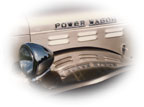
Parked near the
shop is an old Power Wagon, once blue and
black. The blue parts of the truck have aged
to near-black. All surfaces are truly dull.
Remarkably, the top of the cab is perfect;
smooth and rounded. No dents.
There is a pickup
box. There is no tailgate. The back of the
truck is filled with all manner of jutting
iron – big channel, beam and angle – anchoring
a long boom reaching out into the atmosphere.
A heavy cable
dangling with no load from a pulley at the
high end of the joined boom tubes is stiff and
just a little curved, terminating in a great,
age-browned slip hook. Other cables, along
with chain, truss the boom.
At the fore end of
the bed rests a big winch of huge, rounded
castings bearing the name Tulsa. The assembly
oozes heavy oil.
Wide roller chain
rises through a slot in the box floor,
reaching a sprocket on the winch. The chain
links display the sheen of lubrication and
attention, marked in contrast with the dull of
box sheetmetal and bed wood. Heavy tread plate
forms a distinct, rectangular section,
defining the area occupied by winch and boom
underpinning.
A no-nonsense push
bumper fills out the front of the rig, replete
with grab hooks, bolted shackles, and
carefully hand burned openings for the passage
and snagging of big links of log chain. In the
middle of the bumper is a Braden MU2, the
spool wrapped completely full with carefully
laid and well oiled cable.
The rear of the
truck has a unique bumper, square in
cross-section and fitted with hardware
supporting props that can be swiveled down to
point at the earth. These props are
telescoping; held in place by big pins, and
shod in thick, square plates. Stitching all
this mass together are unrelenting beads of
arc weld.
There is a massive
pintle hook, with clever and substantial
provision for changing the elevation of the
hook, as well as removal and replacement with
ball hitches or other implements of pull.
Several hitch balls of different sizes are
lined up for selection, stored in a series of
holes provided.
On the driver's
running board, right along side of the fore
end of the pickup box, there is a metal box
with lid. A sturdy hasp secures a lid
fabricated from tread plate, allowing the box
to double as a step into the truck bed. Inside
this step box are compartments, each filled
with long chains; some 3/8", some 5/16", and
one with 1/2" chain. Forged grab hooks –
marked U.S.A. – on all.
Big, handsome
double-faced lights sit atop the front
fenders, bearing amber to the front and red to
the rear. Dietz is the brand, chrome are the
bezels. A chrome spotlight is attached to the
left side of the windshield.
A look inside the
cab reveals a heavy-duty turn signal switch
attached to the steering column. Across the
cab, mounted on the dash, is a defroster fan
pointed upward at the driver's side of the
windshield. There is a switch on the dash
marked Micro-Lock.
Levers rise from
the floor; PTO, transmission and transfer
case. More chain and a snatch block can be
seen on the passenger's side. In the middle of
the chain, rising from the iron tangle, is a
hydraulic jack. Also bobbing in this brown,
iron surf are hitch pins, shackles, and a few
odd combinations of grab hooks and clevises.
Chrome from one end of a 3/4 drive breaker bar
protrudes, a gleam interrupting the brown.
Not much room left
for passenger feet. Appropriately, the
windshield says No Riders.
Leather gloves with
wide cuffs rest on the seat cushion. Ready for
the next job.
The old man seems
to have everything he needs.
Conclusion
You keep a six-foot
bar, sledgehammer, ratcheting chain winch, and
an acetylene torch in your shop. Such items
are not for amusement. They are kept and
valued because they provide final
solutions to otherwise impossible
challenges.
So it is with the
Power Wagon. It is not fast. It is not pretty,
though you do come to believe it is beautiful.
It will not be stopped. It becomes
immaterial that it gets there slowly. It gets
there.
You realize, after
due consideration, that you are honored to be
in its presence. You sit nearby, silently
regarding it, remembering the great deeds.
The truck is brute
force, densely packed into a small space,
creating a heavy package – entirely portable –
capable of traversing impossible terrain to
reach the most remote location.
We envy these
trucks – if machines can be envied – for their
confidence, rugged construction, and ability
to perform under the worst conditions. We can
only hope to be the stalwart friends they have
been for us, for as long as we have known
them.
A man wants a
friend like this truck, and wishes to be
worthy of the friendship.
Common beliefs such
as these have brought us together. Join with
us each month to celebrate our common values
and ideals. Learn from others how to be
self-reliant in your own way, with your own
tools, in a manner that brings you quiet
pride.
Matthew
Welcher
Editor, Power Wagon Advertiser
|